Sunday, June 17, 2012

Friday, June 08, 2012
Friday, March 16, 2012

Monday, January 09, 2012
Swiss National Bank's Hildebrand Resigns
It was my wife's fault, but I will resign anyway. What will this do to the currency? I know you'd rather read about Tebow.
http://www.washingtonpost.com/business/industries/swiss-national-bank-says-chairman-hildebrand-resigns-amid-uproar-over-private-forex-trade/2012/01/09/gIQAMEUKlP_story.html
http://www.washingtonpost.com/business/industries/swiss-national-bank-says-chairman-hildebrand-resigns-amid-uproar-over-private-forex-trade/2012/01/09/gIQAMEUKlP_story.html
Thursday, January 05, 2012
Chairman of the Swiss National Bank's Press Conference
Read this glimpse into what Chairman Philip Hildebrand claims was his wife's fault.
http://www.snb.ch/en/mmr/speeches/id/ref_20120105_pmh/source/ref_20120105_pmh.en.pdf
http://www.snb.ch/en/mmr/speeches/id/ref_20120105_pmh/source/ref_20120105_pmh.en.pdf
Friday, December 16, 2011
Tom's Tea Leaves
Gold is testing support at 1530-1550 an ounce and may be showing a trend change. Point & figure charts are showing a bearish target for the SPDR Gold Trust Shares (GLD) of 144--an 11 point move to the downside--while the bearish target for the gold spot price is $1370. The Ichimoku daily chart for GLD shows a strong sell signal with the price falling below the kijun-sen, the tenkan-sen, and the kumo. Additionally, the chikou span and senkou span are bearish. With risk to the downside, I would suggest hedging your long gold positions, or moving from gold to cash on a bounce. The US$ has been strong and that partly explains why Gold is heading lower. (Click on a graph to see a larger version.)


Tuesday, December 13, 2011
Financial Development Report
The World Economic Forum has published its 4th Annual Financial Development Report. Hong Kong is number one this year, bumping the USA to the number 2 position. Lots of data in this 427 page report.
http://www3.weforum.org/docs/WEF_FinancialDevelopmentReport_2011.pdf
http://www3.weforum.org/docs/WEF_FinancialDevelopmentReport_2011.pdf
Commerzbank's Merz (Garbage)

http://www.reuters.com/article/2011/12/13/commerzbank-idUSL6E7ND34920111213
Thursday, December 01, 2011
Bank of England Statement on Financial Stability
Full Text: Statement By BOE King On Financial Stability
LONDON (MNI) – The following is Bank of England Governor Mervyn King’s opening statement at the December Financial Stability Report press conference.
“Faced with a crisis of the euro-area system, we are seeing at first hand the costs of financial instability. The symptoms of the crisis have been widely reported. Many European governments are seeing the price of their bonds fall, undermining banks balance sheets. In response, banks, especially in the euro area, are selling assets and deleveraging. An erosion of confidence, lower asset prices and tighter credit conditions are further damaging the prospects for economic activity and will affect the ability of companies, households and governments to repay their debts. That, in turn, will weaken banks’ balance sheets further. This spiral is characteristic of a systemic crisis.
Tackling the symptoms of the crisis without resolving the underlying causes, by measures such as providing liquidity to banks or sovereigns, offers only short-term relief. Ultimately governments will have to confront the underlying causes. A loss of external competitiveness in some euro-area countries has led to current account imbalances and large build-ups of private and public debt, much of it external. The problems in the euro area are part of the wider imbalances in the world economy. The end result of such imbalances is a refusal by the private sector to continue financing deficits, as the ability of borrowers to repay is called into question. Resolving these wider problems is beyond the control of any UK authority. The responsibility of the Financial Policy Committee is to focus on measures that can protect and enhance the resilience of the UK financial system in this threatening environment, and ensure it is better equipped to counter even more serious potential problems further down the road. It is crucially important that we avoid causing individual banks to seek to strengthen their balance sheets in such a way that, when taken together with similar actions by others, may cause harm to the wider economy.
So what does the Financial Policy Committee recommend? First, following its recommendation from September, and given the current exceptionally threatening environment, the Committee recommends
that, if earnings are insufficient to build capital levels further, banks should limit distributions and give serious consideration to raising external capital in the coming months. This recommendation does not reflect a view on the Committee that the current level of capital in individual UK banks is insufficient. Indeed, UK banks are better capitalised than many of their Continental peers. Rather, it reflects a judgement that it is sensible and desirable to raise capital buffers further in order to improve resilience in light of the continuing threats to UK financial stability, while at the same time enhancing the capacity of banks to provide credit to the wider economy. That is why the recommendation is framed in terms of levels of capital and not capital ratios.
It is important that attempts by banks to improve resilience by adjusting their asset holdings do not reinforce the strains in financial markets or threaten the supply of credit to businesses and households. Therefore in its second recommendation, the Committee reiterates its advice to the FSA to encourage banks to improve the resilience of their balance sheets without exacerbating market fragility or reducing lending to the real economy. It is also important that investors are able to make a clear assessment of the strength of banks’ balance sheets. The Committee recognises that concerns about the opacity of the internal risk weights used by banks in calculating regulatory capital ratios can undermine confidence in those measures. As a result, leverage ratios, which do not depend on risk weights, are useful additional indicators of capital adequacy. Under Basel III banks will have to calculate a leverage ratio from 2013, although they will not have to begin reporting it until 2015. Given its potential usefulness to investors, the Committee recommends that the FSA encourages banks to disclose their leverage ratios, as defined in the Basel III agreement, as part of their regular reporting not later than the beginning of 2013.
Alongside an account of the analysis underpinning those recommendations, the Financial Stability Report covers the progress made in implementing our previous recommendations. Section 4 describes that progress. Let me report back briefly on the work completed so far. The FSAs investigations have shown that the direct exposures of smaller UK institutions to the banks and governments of the European nations worst affected by the crisis are small; 3 that current forbearance and provisioning practices are, by themselves, unlikely to pose a threat to systemic stability; and that opaque structures such as collateral swaps and similar transactions employed by exchange-traded funds constitute only a small part of UK banks’ funding at present.
The crisis in the euro area is one of solvency and not liquidity. And the interconnectedness of major banks means that banking systems, and hence economies, around the world are all affected. Only the governments directly involved can find a way out of the crisis. But here in the UK, we must try to bolster the resilience of our financial system, better to withstand the storms that may come in our direction.”
–London newsroom: 4420 7862 7491 e-mail: drobinson@marketnews.com
“Faced with a crisis of the euro-area system, we are seeing at first hand the costs of financial instability. The symptoms of the crisis have been widely reported. Many European governments are seeing the price of their bonds fall, undermining banks balance sheets. In response, banks, especially in the euro area, are selling assets and deleveraging. An erosion of confidence, lower asset prices and tighter credit conditions are further damaging the prospects for economic activity and will affect the ability of companies, households and governments to repay their debts. That, in turn, will weaken banks’ balance sheets further. This spiral is characteristic of a systemic crisis.
Tackling the symptoms of the crisis without resolving the underlying causes, by measures such as providing liquidity to banks or sovereigns, offers only short-term relief. Ultimately governments will have to confront the underlying causes. A loss of external competitiveness in some euro-area countries has led to current account imbalances and large build-ups of private and public debt, much of it external. The problems in the euro area are part of the wider imbalances in the world economy. The end result of such imbalances is a refusal by the private sector to continue financing deficits, as the ability of borrowers to repay is called into question. Resolving these wider problems is beyond the control of any UK authority. The responsibility of the Financial Policy Committee is to focus on measures that can protect and enhance the resilience of the UK financial system in this threatening environment, and ensure it is better equipped to counter even more serious potential problems further down the road. It is crucially important that we avoid causing individual banks to seek to strengthen their balance sheets in such a way that, when taken together with similar actions by others, may cause harm to the wider economy.
So what does the Financial Policy Committee recommend? First, following its recommendation from September, and given the current exceptionally threatening environment, the Committee recommends
that, if earnings are insufficient to build capital levels further, banks should limit distributions and give serious consideration to raising external capital in the coming months. This recommendation does not reflect a view on the Committee that the current level of capital in individual UK banks is insufficient. Indeed, UK banks are better capitalised than many of their Continental peers. Rather, it reflects a judgement that it is sensible and desirable to raise capital buffers further in order to improve resilience in light of the continuing threats to UK financial stability, while at the same time enhancing the capacity of banks to provide credit to the wider economy. That is why the recommendation is framed in terms of levels of capital and not capital ratios.
It is important that attempts by banks to improve resilience by adjusting their asset holdings do not reinforce the strains in financial markets or threaten the supply of credit to businesses and households. Therefore in its second recommendation, the Committee reiterates its advice to the FSA to encourage banks to improve the resilience of their balance sheets without exacerbating market fragility or reducing lending to the real economy. It is also important that investors are able to make a clear assessment of the strength of banks’ balance sheets. The Committee recognises that concerns about the opacity of the internal risk weights used by banks in calculating regulatory capital ratios can undermine confidence in those measures. As a result, leverage ratios, which do not depend on risk weights, are useful additional indicators of capital adequacy. Under Basel III banks will have to calculate a leverage ratio from 2013, although they will not have to begin reporting it until 2015. Given its potential usefulness to investors, the Committee recommends that the FSA encourages banks to disclose their leverage ratios, as defined in the Basel III agreement, as part of their regular reporting not later than the beginning of 2013.
Alongside an account of the analysis underpinning those recommendations, the Financial Stability Report covers the progress made in implementing our previous recommendations. Section 4 describes that progress. Let me report back briefly on the work completed so far. The FSAs investigations have shown that the direct exposures of smaller UK institutions to the banks and governments of the European nations worst affected by the crisis are small; 3 that current forbearance and provisioning practices are, by themselves, unlikely to pose a threat to systemic stability; and that opaque structures such as collateral swaps and similar transactions employed by exchange-traded funds constitute only a small part of UK banks’ funding at present.
The crisis in the euro area is one of solvency and not liquidity. And the interconnectedness of major banks means that banking systems, and hence economies, around the world are all affected. Only the governments directly involved can find a way out of the crisis. But here in the UK, we must try to bolster the resilience of our financial system, better to withstand the storms that may come in our direction.”
–London newsroom: 4420 7862 7491 e-mail: drobinson@marketnews.com
Monday, November 21, 2011
Tom's Tea Leaves
A change worth noting today. Bull correction in the New York Stock Exchange Bullish Percent Index. Defense! A good time to take risk off the table.

Sunday, November 20, 2011
Tom's Tea Leaves
A bearish development. The S&P500 daily point & figure chart shows a bearish triangle breakdown.

Friday, November 18, 2011
Tom's Tea Leaves
Charts courtesy of Stockcharts.com
 Here is the EEM chart. You can get a bigger view if you click on the picture.

This is the SPY chart, looking mildly bearish.


This is the SPY chart, looking mildly bearish.
Friday, August 19, 2011
Recession Probabilities

Bill Gross has a different opinion from Bill Dudley. Both men are very smart. Both have axes to grind.
(Reuters) - Despite "anemic" U.S. growth so far this year, the risk of a double-dip recession is "quite low", a top Federal Reserve policymaker said on Thursday.
"The risk of a recession is somewhat higher than it was six months ago. That said, I think the risk of a recession is still quite low," William Dudley, the president of the Federal Reserve Bank of New York, told New Jersey business leaders.
Dudley said that only some of the restraints on growth, such as high oil prices and Japan's earthquake in the first half of the year, can be considered temporary.
"The risks have risen a little bit, but I think we very much still expect the economy to recover. We expect ... growth to be significantly firmer than it was during the first half of the year," he said. "But obviously there is some concern.
The central bank's policy-setting Federal Open Market Committee (FOMC) took the unprecedented step last week of promising to keep interest rates near zero for a set period of time - at least until mid-2013. The Fed also said it was weighing other options to help strengthen a weak recovery.
Thursday, March 03, 2011

Chairman Bernanke's Testimony before the Senate
March 1, 2011
What he said.
http://www.federalreserve.gov/newsevents/testimony/bernanke20110301a.pdf
What the reaction was.
What he said.
http://www.federalreserve.gov/newsevents/testimony/bernanke20110301a.pdf
What the reaction was.
Thursday, December 30, 2010

Tuesday, October 19, 2010
Merkel says Multiculturalism has failed totally
Germany and the Failure of Multiculturalism is republished with permission of STRATFOR.

Saturday, October 16, 2010
Friday, October 15, 2010
Saturday, October 09, 2010
Wednesday, October 06, 2010
Wu Wei Trading is not a Black Box
Natural skill. Something to think about, or possibly, something not to think about.
Stephen Green--Good Value
Read this book if you get a chance.
He is an Episcopal priest who is also chairman of HSBC, (formerly known as Hong Kong Shanghai Banking Corporation).
http://en.wikipedia.org/wiki/HSBC
He begins his book with a quote from T.S. Eliot's Four Quartets, likes Tielhard de Chardin's Phenomenology of Man better than Thomas Friedman's The World Is Flat. He studied politics, economics and philosophy at Oxford. Later he got a masters degree at MIT. He is very literate and a good writer. In January 2011, he will leave his HSBC duties to become the UK's Minister of State for Trade and Investment--at no pay.
http://en.wikipedia.org/wiki/Stephen_Green_(banker)
Friday, October 01, 2010
Sunday, September 26, 2010
Tuesday, September 21, 2010
Friday, September 17, 2010
Friday, August 27, 2010
Monday, August 16, 2010
Jan Hatzius, Chief Economist at Goldman Sachs
Here is a link to a video interview. Hatzius is one of the powers that be.
http://www.youtube.com/watch?v=tbduexTH_V8
http://www.youtube.com/watch?v=tbduexTH_V8
Parenteau's 2006 Paper at Levy Institute and 2010 article on Financial Balances

In hindsight, this paper would have been good to read in 2006. His advice is pretty expensive (only $497 a year) these days at www.richebacher.com
Parenteau's 2006 Levy Institute Paper (short version)
Moving closer to present time, here is a March 2010 article by Mr. Parenteau wherein he discusses the three sector financial balances approach. I find this conceptual framework important, possibly essential to understanding international economics. I hope you enjoy reading it, too.

http://www.nakedcapitalism.com/2010/03/parenteau-on-fiscal-correctness-and-animal-sacrifices-leading-the-piigs-to-slaughter-part-1.html
Friday, August 13, 2010
Saturday, July 10, 2010
Read What Congress Should Be Reading This Weekend

What did Treas Sec Geithner say about China exchange rates, etc.
Report to Congress on International Economic and Exchange Rate Policies
Friday, July 09, 2010
On Fortune's cap we are not the very button. --Shakespeare

CAD: Another Blowout Employment Number | Kathy Lien | FX360.com
The good news on the Canadian job front supports the recent IMF forecast of the continuing global recovery. Which way is Fortune's wheel turning?
IMF Survey Magazine from July 8
Thursday, July 08, 2010
Five Year Crude Chart and CRB Chart

Below is a link to the CRB Index chart for 5 years.
http://www.barchart.com/chart.php?sym=%24CRB&style=technical&p=WO&d=X&sd=&ed=&size=M&log=0&t=CANDLE&v=0&g=1&evnt=1&late=1&po=1&o1=%24WTIC&a1=on&o2=&o3=&x=35&y=12&indicators=&addindicator=&submitted=1&fpage=&txtDate=#jump
Here is a link to the Federal Reserve's statement regarding M3 issued March 9, 2006
http://www.federalreserve.gov/releases/h6/discm3.htm
What James Turk says appears in a blog
http://kingworldnews.com/kingworldnews/KWN_DailyWeb/Entries/2010/7/8_James_Turk_-_Threat_To_The_US_Dollar.html
His concern about M3 no longer being reported is that it makes it hard to compare the numbers to those of the early 1930s. He further complains that Eurodollars, a major M3 component, is particularly difficult to model. While this may be true, it is not relevant to the 1930s because at that time there were no Eurodollars. So how would this number be helpful?
His statistical evidence for inflation is misleading, if not false. Please compare his statements about oil prices and CRB Index with the historical information in the charts above. He fails to mention that oil prices are about 50% lower today than they were at their height, a few months before he started his comparison.
James Turk, founder of goldmoney.com, may be a good gold and silver salesman, but his statistical arguments are not cogent.
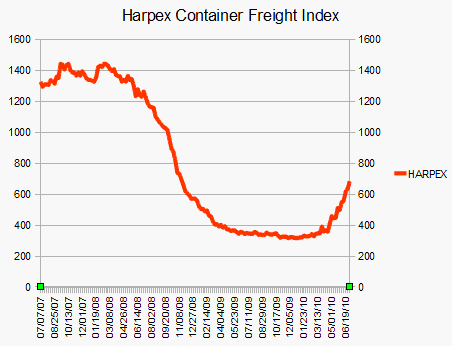
HARPEX Container Freight Index

HARPEX Container Freight Index
Despite a 30 day decline in the Baltic Dry Index, the container freight index is rising.
Collin Twiggs had this to say about the rising container index and steel prices today
"This leads me to believe that steel (?) (iron ore and coal?) stockpiled during the worst of the financial crisis is now being used for production, resulting in a down-turn in imports without a corresponding fall in manufactured exports — which remain in a healthy up-trend."
Friday, June 04, 2010
Search for meaning

I like these video clips of Viktor Frankl.
http://www.youtube.com/watch?v=fD1512_XJEw
http://www.youtube.com/watch?v=v0GWA7xzCa8&NR=1
Tuesday, April 06, 2010
Economics

A nameless razor fusses.
Today the minutes from the Federal Reserve’s last monetary policy meeting confirmed that central bank officials are in no rush to tighten monetary policy and raise interest rates. According to minutes, central bank officials believe that the economy is moving in the right direction with economic activity expanding at a moderate pace in early 2010.
Tuesday, August 25, 2009
President Obama Moves Early to Reappoint Bernanke

President Barack Obama on Tuesday announced plans to keep Federal Reserve Chairman Ben Bernanke in his job for another term.
I'm glad. Daniel K. Tarullo is not ready for prime time, in my humble opinion. Despite the opportunity the President had to appoint his own man to this hotseat of power, he chose a greater good. The cachet of credibility.
Tuesday, July 21, 2009
Introducing Daniel K. Tarullo

When Bernanke's term ends in January, will Obama replace him or keep him?
Although I think it would be better to keep him on, since he is a known quantity in these turbulent financial times, I think Obama will find it very difficult not to put his own stamp on a power position he has a chance to appoint. Since the federal reserve chairman has a term of 4 years, appointed by the president, and subject to Senate confirmation, Obama may not get another chance to make this change. (Although he is sure he will serve a second term at this point.)
If you recall, President Bush brought Bernanke in to serve as his chairman of his Council of Economic Advisors for awhile before deciding on him to replace Alan Greenspan. Bernanke was a governor of the Federal Reserve at the time. Obama's council has no FRB governors on it.
http://www.whitehouse.gov/administration/eop/cea/members/
The president must choose from sitting governors of the Fed. That limits his choice to the following list. Donald L. Kohn, the current vice chairman, Kevin M. Warsh, Elizabeth A Duke, and Daniel K. Tarullo. Although Bernanke would no longer be the Chairman, he would still have the rest of his 14-year term as a governor to serve. So he would still be there in the woodwork.
http://www.federalreserve.gov/aboutthefed/default.htm
Daniel K. Tarullo is the ringer on this board of governors. He took office on January 28, 2009. He is a law professor from Georgetown. He held several senior positions in the Clinton administration. Before that, he served on the staff of Senator Edward Kennedy and practiced law in Washington, DC. He also taught at Harvard Law School and was a visiting professor at Princeton. Not any experience as a central banker. He is Obama's man. But surely not, you say.
Time will tell.
Friday, June 12, 2009
Trading is Like Starting a Fire with Flint & Steel

Trading Forex or futures markets is like starting a fire with flint and steel. A lot depends on your kit and your skill, but a lot depends on the elements. What you have in mind is building a nice fire. That would be a healthy winning trade. Striking your flint and steel together would be taking a position in the market. The tinder would be the amount you are willing to risk on the trade. The kindling would be having your trade go in your favor by the amount of your risk capital (tinder). A log would be the trend. Getting the logs to burn comes about by catching the trend and riding it.
The day-trader is always concerned with striking his flint with the steel and not getting burnt. Sometimes it seems to be raining or windy or both. You don't get much started. The experienced fire starter looks for the best kindling and tinder. Patiently waits for his trade to set up. The impatient one keeps burning tinder and char cloth but all too often the fire dies. Fire starting is a survival skill that can be learned. A forex trader who approaches the market as a problem in fire starting could do worse. We trade our beliefs about the market.
Wednesday, May 27, 2009
Watch the Markets

I don't know of any substitute for watching the market. When you take your eye off, you might as well be unconscious. But with 24 hour markets, this is not easy. Picking your hours of alert watching is an important choice. You have to decide what you can live with. Some people only look once a week, trading from the weekly charts. Some try to watch every tick for 10 hours in 15 markets simultaneously.
Being committed to certain markets is an important key. My current thinking is that I need to watch 4 to 6 markets intensely from about 6AM EST to around 3PM, with glances at a bunch of others. I give my most intense attention to oil, namely the July Crude Oil Futures contract and the USD/CAD forex pair. My next favorite are the Treasury Bond and 10-year Treasury Note markets. Then comes S&P500 e-mini and a few others.
The commitment is to a continuous monitoring of the market. For me there are emotional reasons why I find this difficult. When I trade, I am emotionally involved. When I close a position there is a kind of emotional disconnect that occurs. Especially if I have a losing trade. I stop watching. But the battle still rages.
Watching the market has to be your number one commitment. Without that, you miss the moves. Orienting yourself to the trend must be a second important duty.
Thursday, May 21, 2009
Tuesday, May 19, 2009
The Euro as Substitute for S and P Futures


As long as we are exploring the concept of trading the USD/CAD pair in lieu of the more expensive crude oil futures, why not test the idea of EUR/USD as a way of trading the S&P futures? This could be interesting. Today it would have worked pretty well.
The charts, compliments of INO, are 5 minute candlestick charts from today.
Saturday, May 16, 2009
Basics of Diplomacy

. . . diplomacy is about trying to understand other people. Finding out what will encourage them to agree with you and what will prevent them. Having a well reasoned argument rarely works on its own.
--John Duncan, UK's Ambassador for Multilateral Arms Control and Disarmament
Somehow the forces that move the currency markets might yield lessons to the basics of diplomacy. Agreement could be when the market price is not moving--equilibrium. Or it could be when the market is moving--trend. The markets are composed of people. What will encourage them to agree with you? Support and resistance? Trading ranges. What will prevent them agreeing? Loss of equilibrium. Thus the currency trader studies diplomacy in order to succeed. The market is like negotiating a treaty. Could be a chapter in Elephant Theories.
Friday, May 15, 2009
What Action Are You Creating Today?

"Here I am planting the millionth tree. What action are you creating today?"
This picture of Governor Schwarzenegger comes from twitter http://twitpic.com/3slai
Tuesday, May 12, 2009
When Trading the USD/CAD as a Substitute for Crude
The 85% correlation between the USD/CAD and the price of crude oil makes trading the Loonie a convenient substitute for the relatively expensive crude oil futures contract. Each might go about this in his own way, but I am thinking it would be a good idea to keep on eye on the crude futures chart and the Loonie both, when attempting this strategy.
That way, when your position in the USD/CAD starts going wrong, you can check to see if the crude prices are moving a different way than you wanted and take corrective measures. For example, this morning, oil prices were up, Canadian trade balance was up. Loonie was stronger. It tested $1.1550 and bounced. I expected it to do a normal bounce and continue settling lower, but it bounced over 100 pips, thus stopping me out. Crude prices had fallen from the time of the bounce. I wasn't watching. So now I will watch. Just a tip.
I seem to be the kind of trader that would benefit from the discipline of a no-loss stop once the trade has gone in my favor say 30 or 40 pips. While this is not entirely satisfactory, it has the advantage of not losing money on the trade.
That way, when your position in the USD/CAD starts going wrong, you can check to see if the crude prices are moving a different way than you wanted and take corrective measures. For example, this morning, oil prices were up, Canadian trade balance was up. Loonie was stronger. It tested $1.1550 and bounced. I expected it to do a normal bounce and continue settling lower, but it bounced over 100 pips, thus stopping me out. Crude prices had fallen from the time of the bounce. I wasn't watching. So now I will watch. Just a tip.
I seem to be the kind of trader that would benefit from the discipline of a no-loss stop once the trade has gone in my favor say 30 or 40 pips. While this is not entirely satisfactory, it has the advantage of not losing money on the trade.
Monday, May 11, 2009
Shoulda Woulda Coulda

According to this video by Oliver North, one of the five principles for a successful life is never play Shoulda Woulda Coulda. I didn't know he was a forex trader. Do you think he was reading my mind?
http://www.youtube.com/watch?v=_yFUB-fIg04&eurl=http%3A%2F%2Fwww.5principlesoflife.com%2FpIndex.html&feature=player_embedded
Saturday, May 09, 2009
Three Little Rules

Three little rules
Jamie’s rules for forex traders:
1. Understand the basics of technical analysis. You don’t need to be a quant-geek to be successful, but understanding the first ten chapters or so of the classic Technical Analysis of the Futures Markets: A Comprehensive Guide to Trading Methods and Applications by John J. Murphy would be a great start.
2. When the fundamental and technical outlooks for a currency differ, always side with the techs.
3. When the fundamental and technical outlooks for a currency converge, go for it! Take a more aggressive position than normal.
Jamie Coleman of ForexLive.com offers these pearls. I ordered John J. Murphy's book, as suggested in Rule 1, and was pleased to learn that Chapter One, Philosophy of Technical Analysis, reveals the source of Jamie's Rule 2.
The problem is that the charts and fundamentals are often in conflict with each other. Usually at the beginning of important market moves, the fundamentals do not explain or support what the market seems to be doing. It is at these critical times in the trend that these two approaches seem to differ the most. Usually they come back into sync at some point, but often too late for the trader to act.My own recent experience with the current bear market rally in stocks had me taking quick profits and moving back to the sidelines, waiting for the inevitable correction. It still hasn't come. I stayed out, based on the fundamentals not improving much. Yet the trend took off and left me there waiting for the correction. In this case, the wisdom of rule number two becomes apparent. Market price did indeed lead the known fundamentals. AIG went from 36 cents to $2, etc.
One explanation for these seeming discrepancies is that market price tends to lead the known fundamentals. Stated another way, market price acts as a leading indicator of the fundamentals or the conventional wisdom of the moment. --p. 5
Jamie Coleman's 'little rules' are expressed so simply, they embody the quality of the Italian word, sprezzatura, a term that originates from Castiglione’s The Book of the Courtier. It is defined as “a certain nonchalance, so as to conceal all art and make whatever one does or says appear to be without effort and almost without any thought about it.
These nonchalant rules helped me to sort out the relative importances of fundamental and technical analysis when they are in conflict. Thanks, Jamie.
http://en.wikipedia.org/wiki/Sprezzatura
I picked up a nice used copy of John J. Murphy's classic at my favorite shopping place. http://www.abebooks.com/
Thursday, May 07, 2009
High Traffic Business and Econ Websites
Here is some good information. What do all these people know
that I don't?
http://www.gongol.com/lists/bizeconsites/
that I don't?
http://www.gongol.com/lists/bizeconsites/
Wednesday, May 06, 2009
The Quotable Gerry Davies
Gerry Davies of ForexLive provides very colorful commentary from the UK. He lives in East Anglia. Gerry Davies has over twenty three years experience in global financial markets. He has worked as a market analyst for twelve years, the majority of that time employed by Thomson Financial. Gerry spent three years working in the company’s London office, before relocating to the U.S. where he worked out of the Boston office holding the position of Regional Director Foreign Exchange.
Prior to his work as a market analyst, Gerry spent eleven years trading foreign exchange and money markets at a number of international banks, including Canadian Imperial Bank of Commerce, United Overseas Bank, Credit Commercial de France and Manufacturers Hanover Trust Co.
His perspective on the markets is invaluable. I liked this quote from today. "Anyways, I’m a borne again optimist, and I’m increasingly convinced the worst is over regarding the global economic crisis (remember Gerry, think HAPPY thoughts.)"
Prior to his work as a market analyst, Gerry spent eleven years trading foreign exchange and money markets at a number of international banks, including Canadian Imperial Bank of Commerce, United Overseas Bank, Credit Commercial de France and Manufacturers Hanover Trust Co.
His perspective on the markets is invaluable. I liked this quote from today. "Anyways, I’m a borne again optimist, and I’m increasingly convinced the worst is over regarding the global economic crisis (remember Gerry, think HAPPY thoughts.)"
Tuesday, May 05, 2009
A Way To Trade Oil
Kathy Lien, that incisive and energetic currency analyst, said something today I found especially interesting. "Over the past year, the positive correlation between oil prices and the Canadian dollar / U.S. dollar currency pair is more than 95 percent."
Seems like someone whose account wouldn't accommodate an oil future's contract, may be able to trade the Canadian Dollar instead. The trick is in finding a time frame and stop that keeps you following the trend without whipsawing you all the time. I find the Loony to be very choppy.
For a look at her chart, click on the link.
cadoil050509.jpg (JPEG Image, 647x354 pixels)
Seems like someone whose account wouldn't accommodate an oil future's contract, may be able to trade the Canadian Dollar instead. The trick is in finding a time frame and stop that keeps you following the trend without whipsawing you all the time. I find the Loony to be very choppy.
For a look at her chart, click on the link.
cadoil050509.jpg (JPEG Image, 647x354 pixels)
Sunday, May 03, 2009
Jame Coleman says Tell My Friends
I followed Jamie Coleman's commentary closely a few years ago when he was with Thompson Financial. I lost touch with him for awhile, but found him again at www.ForexLive.com. This is good news. I think you will like his insightful observations. Sometimes he seems to know the future. But of course, no one does.
Jamie Coleman
Prior to launching ForexLive, Jamie Coleman spent nearly twelve years at Thomson Financial as managing analyst of the institutional forex product IFR Forex Watch. In 2007, he left the Forex Watch team to launch a retail forex-oriented site which became the popular Reuters FX Hub. FX Hub fell victim to cost cutting after the sub-prime mortgage crisis swamped the financial markets in 2008.
Prior to his work as a market analyst, Jamie spent 12 years trading spot and forward foreign exchange at a number of major banks including, ABN Amro, ING and NatWest USA. His biggest career break as a trader, being hired as chief dealer at Baring Securities in New York in February 1995, was derailed by Nick Leeson, one of the great rogue traders of market lore.
Jamie is a native New Yorker and graduate of Georgetown University.
Jamie Coleman
Prior to launching ForexLive, Jamie Coleman spent nearly twelve years at Thomson Financial as managing analyst of the institutional forex product IFR Forex Watch. In 2007, he left the Forex Watch team to launch a retail forex-oriented site which became the popular Reuters FX Hub. FX Hub fell victim to cost cutting after the sub-prime mortgage crisis swamped the financial markets in 2008.
Prior to his work as a market analyst, Jamie spent 12 years trading spot and forward foreign exchange at a number of major banks including, ABN Amro, ING and NatWest USA. His biggest career break as a trader, being hired as chief dealer at Baring Securities in New York in February 1995, was derailed by Nick Leeson, one of the great rogue traders of market lore.
Jamie is a native New Yorker and graduate of Georgetown University.
Saturday, May 02, 2009
All Atwitter
My blog is now upgraded and I hope to have a Twitter feature soon. I hope you enjoy the new look and functionality.
Thursday, September 13, 2007
Halsey's Poetry
A friend of mine has been writing poetry for years, but didn't show much of it until very recently. Poetry writing is so personal that it takes courage to 'show off' (believe me, I heard dat.)
If he consents, I will publish a link to his blog so my many readers can experience these thoughtfully crafted verses.
If he consents, I will publish a link to his blog so my many readers can experience these thoughtfully crafted verses.
Monday, August 20, 2007
Peter Drucker Article
Dr. Peter Drucker, the dean of management consultants, met this past winter with members of the US Congress. His remarks are relevant and instructive as we ponder the potential of government in this particularly unpromising election year. We've excerpted them from What's Next: A Newsletter of Emerging Issues and Trends, which is published by the Congressional Clearinghouse on the Future. You can reach the Clearinghouse at 555 House Annex 2, Washington, DC, 20515 Tel. 202/226-3434.
Every 200 or 300 years, there is a very short period when the world suddenly changes - the way it does in a kaleidoscope. This is one of those periods when the old solutions no longer work. One can clearly see new priorities.
Since the French Revolution, we have believed in what I call "salvation by society," the belief that government and society could basically mold the human being. Communism was the extreme manifestation of this secular religion. In this country, that belief peaked in the Kennedy years, and by now, it is pretty much gone. It is gone in the rest of the world, too. And so we have a world that has no ideologies. We can expect that within 20 or 30 years, we will have major new political alignments. In this country, our parties have never been ideological. [...]
For 200 years, all the debates have been over what should be done. Since 1792, nobody has asked, what can government do? Now, for the first time, we are asking the question. Government, like any other institution, has core competencies. We have learned from other institutions what happens when institutions try to do things that don't fit their competence - they usually end up flat on their belly. Of all government [social] programs of the last 40 years, not one has worked. Head Start is the only exception. This is not an American phenomenon; it is worldwide. Japan is an exception, [but] it is beginning to hit Japan. [...]
We started the Core Management Foundation one and one-half years ago with the avowed aim of tripling the effectiveness of nonprofit institutions and doubling their share of the GNP. Those are realistic, but not easy, goals.
One of the great movements in my lifetime among educated people is the need to commit themselves to action. Most people are not satisfied with giving money; we also feel we need to work. That is why there is an enormous surge in the number of unpaid staff, volunteers. The needs are not going to go away. Business is not going to take up the slack, and government cannot.
I think we will depend on the nonprofits. The nonprofit sector is the largest employer in the American economy.
Productivity [in manufacturing and agriculture] has increased 50-fold in the last century ... and is growing as fast as ever. [Now] both sectors together employ fewer than one-sixth of the labor force. [...]
Knowledge has become the central resource. [But] the productivity of knowledge workers is incredibly low. Does anybody here believe that the teacher of 1991 is more productive than the teacher of 1900? The productivity of service workers is even lower.... Over three-fourths of our workforce are service and knowledge workers. By the end of the century, 90 per cent of total workers will be knowledge and service workers. Productivity of knowledge work and dignity of service work are the two great priorities.
Please support this web site ... and thanks if you already are!
All contents copyright (c)1992, 1996 by Context Institute
Every 200 or 300 years, there is a very short period when the world suddenly changes - the way it does in a kaleidoscope. This is one of those periods when the old solutions no longer work. One can clearly see new priorities.
Since the French Revolution, we have believed in what I call "salvation by society," the belief that government and society could basically mold the human being. Communism was the extreme manifestation of this secular religion. In this country, that belief peaked in the Kennedy years, and by now, it is pretty much gone. It is gone in the rest of the world, too. And so we have a world that has no ideologies. We can expect that within 20 or 30 years, we will have major new political alignments. In this country, our parties have never been ideological. [...]
For 200 years, all the debates have been over what should be done. Since 1792, nobody has asked, what can government do? Now, for the first time, we are asking the question. Government, like any other institution, has core competencies. We have learned from other institutions what happens when institutions try to do things that don't fit their competence - they usually end up flat on their belly. Of all government [social] programs of the last 40 years, not one has worked. Head Start is the only exception. This is not an American phenomenon; it is worldwide. Japan is an exception, [but] it is beginning to hit Japan. [...]
We started the Core Management Foundation one and one-half years ago with the avowed aim of tripling the effectiveness of nonprofit institutions and doubling their share of the GNP. Those are realistic, but not easy, goals.
One of the great movements in my lifetime among educated people is the need to commit themselves to action. Most people are not satisfied with giving money; we also feel we need to work. That is why there is an enormous surge in the number of unpaid staff, volunteers. The needs are not going to go away. Business is not going to take up the slack, and government cannot.
I think we will depend on the nonprofits. The nonprofit sector is the largest employer in the American economy.
Productivity [in manufacturing and agriculture] has increased 50-fold in the last century ... and is growing as fast as ever. [Now] both sectors together employ fewer than one-sixth of the labor force. [...]
Knowledge has become the central resource. [But] the productivity of knowledge workers is incredibly low. Does anybody here believe that the teacher of 1991 is more productive than the teacher of 1900? The productivity of service workers is even lower.... Over three-fourths of our workforce are service and knowledge workers. By the end of the century, 90 per cent of total workers will be knowledge and service workers. Productivity of knowledge work and dignity of service work are the two great priorities.
Please support this web site ... and thanks if you already are!
All contents copyright (c)1992, 1996 by Context Institute
Friday, November 10, 2006
Thursday, September 14, 2006
Wednesday, February 15, 2006
FRB: Monetary Policy Report to the Congress - February 15, 2006
FRB: Monetary Policy Report to the Congress - February 15, 2006
Follow the link to see the text of the new Fed Chairman's first report to the Congress. I can tell you that the currency markets are very interested.
U.S. Treasury - Treasury International Capital System - Home Page
U.S. Treasury - Treasury International Capital System - Home Page
The current account deficit is still being comfortably funded despite news media hysteria. US securities of $185 billion were bought with international capital inflows last year above and beyond the current account deficit. --tb
Thursday, February 02, 2006
FRB: Speech, Greenspan--Acceptance of honorary degree from New York University--December 14, 2005
FRB: Speech, Greenspan--Acceptance of honorary degree from New York University--December 14, 2005
"Open and free markets are the antithesis of violence." I like that quote.
"Open and free markets are the antithesis of violence." I like that quote.
Friday, January 27, 2006
Tai Chi Currency Trading
Stay out of the market and don't get hit. Stick and follow the charging elephant.
Friday, January 20, 2006
New Zealand Banker Predicts Euro's fall to $1.19 in a week
Bloomberg.com: Currencies: "The euro will probably decline because it has been unable to extend its 2 percent advance this year through a key level on charts traders watch to predict price movements, said Sue Trinh, a currency strategist at Bank of New Zealand Ltd.
``The continued failure to breach topside resistance at $1.22 will see some investors turn bearish on the single currency,'' said Trinh, who is based in Wellington. A resistance level is a price where sell orders may be clustered.
The euro may fall to $1.19 within a week, she said"
``The continued failure to breach topside resistance at $1.22 will see some investors turn bearish on the single currency,'' said Trinh, who is based in Wellington. A resistance level is a price where sell orders may be clustered.
The euro may fall to $1.19 within a week, she said"
Thursday, January 19, 2006
Currencies: Dollar lifted late in day after Guynn speech - Financial - Financial Services - Currencies
Currencies: Dollar lifted late in day after Guynn speech - Financial - Financial Services - Currencies: "'Any time you have credible evidence of terrorism in the U.S. or abroad, it works against the dollar,' said Michael Woolfolk, senior currency analyst at Bank of New York."
Monday, January 02, 2006
Bloomberg.com: Market Insight
Bloomberg.com: Market Insight
Click on the red text to go to the link. It's kind of a report of who won the superbowl of currency forecasting. Merrill Lynch, which won in 2004, fell to 38th this year. Merrill Lynch is the sixth-biggest currency trader on the planet.
Click on the red text to go to the link. It's kind of a report of who won the superbowl of currency forecasting. Merrill Lynch, which won in 2004, fell to 38th this year. Merrill Lynch is the sixth-biggest currency trader on the planet.
Buffett and major traders still see a dip in dollar - Marketplace by Bloomberg - International Herald Tribune
Buffett and major traders still see a dip in dollar - Marketplace by Bloomberg - International Herald Tribune
Buffett reduced his bets on the dollar's decline to $16.5 billion from $21.5 billion in June, according to a statement from Berkshire Hathaway on Nov. 4. The company, which had $926 million of pretax currency losses in the first half, used forward contracts, or agreements to purchase or sell a currency in the future at a preset price.
. . . "The story of the current account deficit allowed traders and analysts to justify any currency prices," said Steve Pearson, chief currency strategist in London at HBOS, a large lender. "Sentiment got overly bearish on the dollar."
Pearson was the most accurate forecaster of exchange rates in the year that ended on Sept. 30.
For 2006, he expects the euro to fall to $1.08.
Buffett reduced his bets on the dollar's decline to $16.5 billion from $21.5 billion in June, according to a statement from Berkshire Hathaway on Nov. 4. The company, which had $926 million of pretax currency losses in the first half, used forward contracts, or agreements to purchase or sell a currency in the future at a preset price.
. . . "The story of the current account deficit allowed traders and analysts to justify any currency prices," said Steve Pearson, chief currency strategist in London at HBOS, a large lender. "Sentiment got overly bearish on the dollar."
Pearson was the most accurate forecaster of exchange rates in the year that ended on Sept. 30.
For 2006, he expects the euro to fall to $1.08.
Saturday, December 31, 2005
Candlesticks, Bamboo Sticks
Currency trading using candlestick charts is similar to observing a bamboo thicket.
But without the serenity. A 30-minute candlestick chart sometimes gives a pattern like the picture. When it does, the market is consolidating quietly. But when the momentum shifts, one must act accordingly. King Kong may have entered your quiet grove.

But without the serenity. A 30-minute candlestick chart sometimes gives a pattern like the picture. When it does, the market is consolidating quietly. But when the momentum shifts, one must act accordingly. King Kong may have entered your quiet grove.
Friday, December 30, 2005
Fine Line
Sometimes trading currency reminds me of this icy bridge. You can see your way ahead for a few feet and it is treacherous, but beyond that it gets mysterious. As Paul McCartney says in his recent song, Fine Line: There is a fine line/ Between recklessness and courage/ It's about time/ You understood which road to take/ It's a fine line/ And your decision makes a difference/ Get it wrong and you'll be making a big mistake//

Thursday, December 29, 2005
Meat Slicer
My year in England spanned fall 1975 to fall 1976. I enjoyed the local traditions, and one especially was the costume of the butcher. I'm glad to see that some things never change. This photo was uploaded to the web today. Trading currency markets is a lot like being a butcher. You take the raw meat and put it in little packages for your customers. It is a traditional occupation with no end in sight. Some people find it exciting?

Monday, December 05, 2005
PIMCO Manages over $463 billion in Assets
Bill Gross, managing director of PIMCO, widely regarded as the country's leading fixed income authority, may be worth a listen when he publishes his outlook.
Friday, December 02, 2005
FRB: Speech, Greenspan--Budget policy--December 2, 2005
Well worth reading and studying. Alan Greenspan is having a farewell party in London this weekend at the G-7 meeting. The text is at www.federalreserve.gov
Thursday, December 01, 2005
Wednesday, November 30, 2005
PIMCO Bonds - IO December 2005
I learned today that William H. Gross, Managing Director of PIMCO (Pacific Investment Management Company) is known as a Bond Guru.
He has just published at www.picmo.com his investment outlook for the next year. One could do worse as far as prophesies go. It is only 4 pages. Well worth a look.
He has just published at www.picmo.com his investment outlook for the next year. One could do worse as far as prophesies go. It is only 4 pages. Well worth a look.
Saturday, November 19, 2005
Monday, October 24, 2005
Bush Names Bernanke to Replace Greenspan
U.S. stocks logged their biggest one-day gain in six months as Bernanke's nomination laid to rest market uncertainty over who would by Greenspan's replacement. Bond prices ended lower on worries a Bernanke Fed could take an easier line on inflation, despite his assurances on Monday that he would steer the central bank along Greenspan's course.
As if these yahoos know why the market went up or down today. So much pretended knowingness.
As if these yahoos know why the market went up or down today. So much pretended knowingness.
Great New Picture of the Author
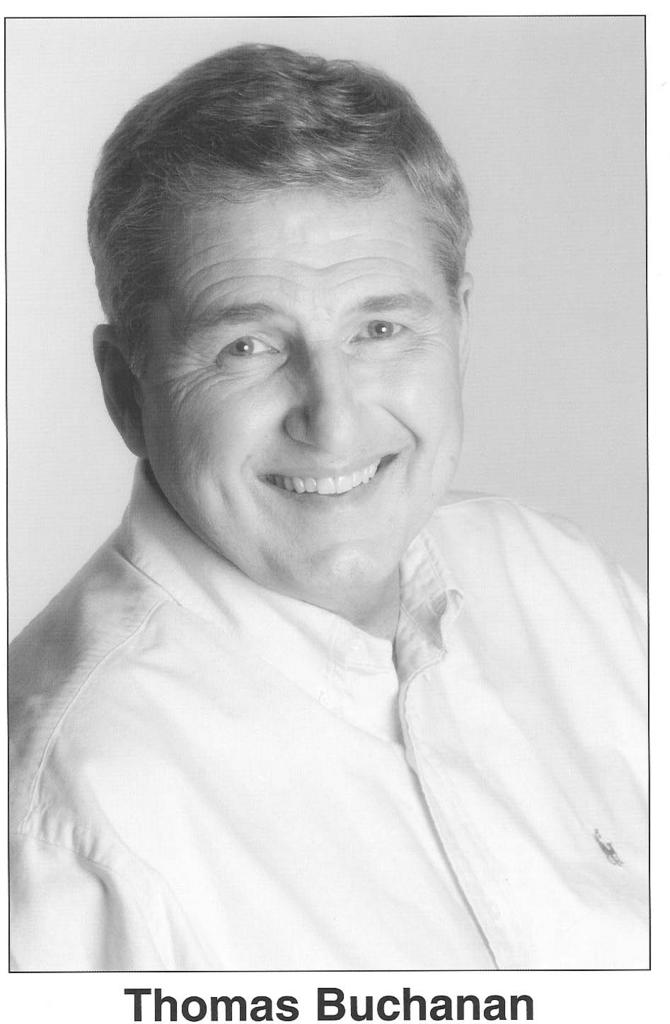
Larry Williams calls The Zurich Axioms "The best book I have had the joy to read on speculation."
The Zurich Axioms Article at Michael Covel Blog
Larry Williams in his book, Trade Stocks & Commodities with the Insiders--Secrets of the COT Report, mentions that Max Gunther's 1985 book The Zurich Axioms is "The best book I have had the joy to read on speculation." A fingernail version is available on this blog. Check it out.
Thursday, October 13, 2005
But he paid it all back with interest on Monday!
On Monday, October 10, Phillip Bennett, CEO of Refco the futures broker, was placed on leave of absence at the Board's request. It was announced that an internal review found that he had failed to disclose owing the company around $430 million. Refco stock had closed around $28 on Friday. It closed on Monday less than $16. Refco said it must restate earnings back to 2002 and delay filing its next quarterly report, originally scheduled for next week.
Bennett was said to have repaid the $430 million with interest Monday.
On Tuesday, October 11, a story about Mr. Bennett and Refco appeared in the Financial Times and many other places. On the same day,
Federman & Sherwood Announces That a Securities Class Action Lawsuit Was Filed Against Refco, Inc.
On October 11, 2005, the class action lawsuit was filed in the United States District Court for the Southern District of New York against Refco, Inc. (NYSE : RFX) . The complaint alleges violations of federal securities laws, Sections 10(b) and 20(a) of the Securities Exchange Act of 1934 and Rule 10b-5, including allegations of issuing a series of material misrepresentations to the market which had the effect of artificially inflating the market price. The class period is from August 11, 2005 through October 7, 2005.
Plaintiff seeks to recover damages on behalf of the Class. If you are a member of the Class as described above, you may move the Court no later than Monday, December 12, 2005, to serve as a lead plaintiff for the Class. However, in order to do so, you must meet certain legal requirements pursuant to the Private Securities Litigation Reform Act of 1995.
If you wish to discuss this action, participate in this suit, or have any questions or concerns regarding this notice, or preservation of your rights, please contact: William B. Federman FEDERMAN & SHERWOOD 120 N. Robinson, Suite 2720 Oklahoma City, OK 73102 (405) 235-1560/FAX: (405) 239-2112 Email to: wfederman@aol.com - http://www.federmanlaw.com
SOURCE Federman & Sherwood William B. Federman of Federman & Sherwood, +1-405-235-1560, or fax, +1-405-239-2112, or wfederman@aol.com http://www.prnewswire.com
That's pretty quick, William Federman of Oklahoma City! The stock closed Tuesday at less than $14.
Warning Issued to Past and Current Shareholders of Refco, Inc. by the Law Firm of Lerach Coughlin Stoia Geller Rudman & Robbins LLP
On October 11, 2005, the law firm of Lerach Coughlin Stoia Geller Rudman & Robbins LLP ("Lerach Coughlin") (http :) (http :) filed a complaint on behalf of all those who purchased the common stock of Refco, Inc. ("Refco" or the "Company") (NYSE :) (NYSE : RFX) . The complaint alleges a series of false and misleading statements associated with the company's accounting practices and follows a lengthy investigation by Lerach Coughlin. Since Lerach Coughlin filed a complaint, The Law of Firm of Schatz & Nobel has issued a press release claiming to offer "information" about joining the suit. Be advised that this firm has not even filed a complaint. Rather, the press release appears to be an advertisement designed to solicit clients so that the firm can participate in this case.
You too are very quick on the draw, Lerach!
On Tuesday, the New York-based Refco said it had voluntarily contacted the Securities and Exchange Commission, the U.S. Commodity Futures Trading Commission, the New York Stock Exchange and other regulators, and was co-operating with their inquiries.
On Wednesday, October 12, Phillip Bennett was arrested by federal prosecutors and charged with securities fraud in U.S. District Court in Manhattan a day after Refco announced that a $430-million-US debt to the company owed by a firm controlled by the ousted chairman and chief executive was hidden through secret transfers to an unnamed customer account.
Securities Fraud Class Action Against Refco, Inc. is Filed by Scott+Scott, LLC
Scott+Scott, LLC (http :) represents investors in a securities class action filed today in the United States District Court for the Southern District of New York against Refco, Inc. ("Refco") (NYSE :) (NYSE : RFX) and certain of its officers and directors. Refco securities purchasers between August 11, 2005 and October 10, 2005, inclusive (the "Class Period") are putative class members. Refco provides execution and clearing services for exchange-traded derivatives, and brokerage services in the fixed income and foreign exchange markets in the United States, Bermuda and the United Kingdom. Refco went public via an initial public offering in August 2005.
Wechsler Harwood LLP Files Securities Class Action Suit Against Refco, Inc. -- RFX
Wechsler Harwood LLP today announced that it has filed a Federal Securities fraud class action suit on behalf of all other persons or entities who purchased or otherwise acquired Refco, Inc. ("Refco" or the "Company") (NYSE :) (NYSE :RFX) common stock pursuant or traceable to the Company's Initial Public Offering ("IPO") on August 11, 2005, and on behalf of all other persons or entities who purchased or otherwise acquired Refco common stock between August 11, 2005 and October 10, 2005, both dates inclusive (the "Class Period").
The action entitled, FrontPoint Financial Services Fund, LP. v. Refco, Inc., et al., Case No. 05-Civ-8663 (DC)(RHM), is pending in the United States District Court for the Southern District of New York seeks to pursue remedies under both the Securities Act of 1933 (the "Securities Act") and the Securities Exchange Act of 1934 (the "Exchange Act") and names as defendants, the Company, certain of its senior officers and directors, as well as its commercial/investment bankers/underwriters involved with the Company's IPO. A copy of the complaint can be obtained from the Court or can be viewed on Wechsler Harwood web site at: www.whesq.com.
Pomerantz Haudek Block Grossman & Gross LLP Commences Securities Class Action Against Refco, Inc. -- RFX
The Pomerantz Firm (www.pomerantzlaw.com) has filed a class action complaint in the United States District Court, Southern District of New York, against Refco, Inc. ("Refco" or the "Company") (NYSE :) has filed a class action complaint in the United States District Court, Southern District of New York, against Refco, Inc. ("Refco" or the "Company") (NYSE :) (NYSE :RFX) , two of its officers, certain underwriters and the Company's outside auditor. The class action was filed on behalf of public investors who purchased the common stock of Refco during the period of August 11, 2005 and October 7, 2005, inclusive (the "Class Period"). It includes those investors who purchased the common stock of Refco pursuant and/or traceable to the Company's initial public offering on August 11, 2005 ("IPO").
Milberg Weiss Announces the Filing of a Class Action Suit against Refco Inc. and Certain of Its Officers and Directors on Behalf of Investors
The law firm of Milberg Weiss Bershad & Schulman LLP announces that a class action lawsuit was filed today on behalf of purchasers of the securities of Refco Inc. ("Refco" or the "Company") (NYSE :) (NYSE : RFX) between August 11, 2005 and October 7, 2005, inclusive (the "Class Period"), including purchasers of the Company's shares pursuant or traceable to the Company's initial public offering (the "Offering") on August 11, 2005. The action seeks to pursue remedies under the Securities Act of 1933 ("Securities Act") and the Securities Exchange Act of 1934 (the "Exchange Act").
Shares dropped 28% on Thursday morning before trading was halted by the New York Stock Exchange.
According to a Bloomberg story today, to remain out of jail, Bennett was forced to pledge his Park Avenue apartment in Manhattan and his country horse farm in New Jersey, along with $55 million in a bond and cash.
Bennett was said to have repaid the $430 million with interest Monday.
On Tuesday, October 11, a story about Mr. Bennett and Refco appeared in the Financial Times and many other places. On the same day,
Federman & Sherwood Announces That a Securities Class Action Lawsuit Was Filed Against Refco, Inc.
On October 11, 2005, the class action lawsuit was filed in the United States District Court for the Southern District of New York against Refco, Inc. (NYSE : RFX) . The complaint alleges violations of federal securities laws, Sections 10(b) and 20(a) of the Securities Exchange Act of 1934 and Rule 10b-5, including allegations of issuing a series of material misrepresentations to the market which had the effect of artificially inflating the market price. The class period is from August 11, 2005 through October 7, 2005.
Plaintiff seeks to recover damages on behalf of the Class. If you are a member of the Class as described above, you may move the Court no later than Monday, December 12, 2005, to serve as a lead plaintiff for the Class. However, in order to do so, you must meet certain legal requirements pursuant to the Private Securities Litigation Reform Act of 1995.
If you wish to discuss this action, participate in this suit, or have any questions or concerns regarding this notice, or preservation of your rights, please contact: William B. Federman FEDERMAN & SHERWOOD 120 N. Robinson, Suite 2720 Oklahoma City, OK 73102 (405) 235-1560/FAX: (405) 239-2112 Email to: wfederman@aol.com - http://www.federmanlaw.com
SOURCE Federman & Sherwood William B. Federman of Federman & Sherwood, +1-405-235-1560, or fax, +1-405-239-2112, or wfederman@aol.com http://www.prnewswire.com
That's pretty quick, William Federman of Oklahoma City! The stock closed Tuesday at less than $14.
Warning Issued to Past and Current Shareholders of Refco, Inc. by the Law Firm of Lerach Coughlin Stoia Geller Rudman & Robbins LLP
On October 11, 2005, the law firm of Lerach Coughlin Stoia Geller Rudman & Robbins LLP ("Lerach Coughlin") (http :) (http :) filed a complaint on behalf of all those who purchased the common stock of Refco, Inc. ("Refco" or the "Company") (NYSE :) (NYSE : RFX) . The complaint alleges a series of false and misleading statements associated with the company's accounting practices and follows a lengthy investigation by Lerach Coughlin. Since Lerach Coughlin filed a complaint, The Law of Firm of Schatz & Nobel has issued a press release claiming to offer "information" about joining the suit. Be advised that this firm has not even filed a complaint. Rather, the press release appears to be an advertisement designed to solicit clients so that the firm can participate in this case.
You too are very quick on the draw, Lerach!
On Tuesday, the New York-based Refco said it had voluntarily contacted the Securities and Exchange Commission, the U.S. Commodity Futures Trading Commission, the New York Stock Exchange and other regulators, and was co-operating with their inquiries.
On Wednesday, October 12, Phillip Bennett was arrested by federal prosecutors and charged with securities fraud in U.S. District Court in Manhattan a day after Refco announced that a $430-million-US debt to the company owed by a firm controlled by the ousted chairman and chief executive was hidden through secret transfers to an unnamed customer account.
Securities Fraud Class Action Against Refco, Inc. is Filed by Scott+Scott, LLC
Scott+Scott, LLC (http :) represents investors in a securities class action filed today in the United States District Court for the Southern District of New York against Refco, Inc. ("Refco") (NYSE :) (NYSE : RFX) and certain of its officers and directors. Refco securities purchasers between August 11, 2005 and October 10, 2005, inclusive (the "Class Period") are putative class members. Refco provides execution and clearing services for exchange-traded derivatives, and brokerage services in the fixed income and foreign exchange markets in the United States, Bermuda and the United Kingdom. Refco went public via an initial public offering in August 2005.
Wechsler Harwood LLP Files Securities Class Action Suit Against Refco, Inc. -- RFX
Wechsler Harwood LLP today announced that it has filed a Federal Securities fraud class action suit on behalf of all other persons or entities who purchased or otherwise acquired Refco, Inc. ("Refco" or the "Company") (NYSE :) (NYSE :RFX) common stock pursuant or traceable to the Company's Initial Public Offering ("IPO") on August 11, 2005, and on behalf of all other persons or entities who purchased or otherwise acquired Refco common stock between August 11, 2005 and October 10, 2005, both dates inclusive (the "Class Period").
The action entitled, FrontPoint Financial Services Fund, LP. v. Refco, Inc., et al., Case No. 05-Civ-8663 (DC)(RHM), is pending in the United States District Court for the Southern District of New York seeks to pursue remedies under both the Securities Act of 1933 (the "Securities Act") and the Securities Exchange Act of 1934 (the "Exchange Act") and names as defendants, the Company, certain of its senior officers and directors, as well as its commercial/investment bankers/underwriters involved with the Company's IPO. A copy of the complaint can be obtained from the Court or can be viewed on Wechsler Harwood web site at: www.whesq.com.
Pomerantz Haudek Block Grossman & Gross LLP Commences Securities Class Action Against Refco, Inc. -- RFX
The Pomerantz Firm (www.pomerantzlaw.com) has filed a class action complaint in the United States District Court, Southern District of New York, against Refco, Inc. ("Refco" or the "Company") (NYSE :) has filed a class action complaint in the United States District Court, Southern District of New York, against Refco, Inc. ("Refco" or the "Company") (NYSE :) (NYSE :RFX) , two of its officers, certain underwriters and the Company's outside auditor. The class action was filed on behalf of public investors who purchased the common stock of Refco during the period of August 11, 2005 and October 7, 2005, inclusive (the "Class Period"). It includes those investors who purchased the common stock of Refco pursuant and/or traceable to the Company's initial public offering on August 11, 2005 ("IPO").
Milberg Weiss Announces the Filing of a Class Action Suit against Refco Inc. and Certain of Its Officers and Directors on Behalf of Investors
The law firm of Milberg Weiss Bershad & Schulman LLP announces that a class action lawsuit was filed today on behalf of purchasers of the securities of Refco Inc. ("Refco" or the "Company") (NYSE :) (NYSE : RFX) between August 11, 2005 and October 7, 2005, inclusive (the "Class Period"), including purchasers of the Company's shares pursuant or traceable to the Company's initial public offering (the "Offering") on August 11, 2005. The action seeks to pursue remedies under the Securities Act of 1933 ("Securities Act") and the Securities Exchange Act of 1934 (the "Exchange Act").
Shares dropped 28% on Thursday morning before trading was halted by the New York Stock Exchange.
According to a Bloomberg story today, to remain out of jail, Bennett was forced to pledge his Park Avenue apartment in Manhattan and his country horse farm in New Jersey, along with $55 million in a bond and cash.
Wednesday, September 21, 2005
FRB: Speech, Greenspan--Reflections on central banking--August 26, 2005
http://www.federalreserve.gov/BoardDocs/speeches/2005/20050826/default.htm
Friday, September 09, 2005
Thinking With Mergers and Acquisitions in terms of Foreign Exchange
FX Power Student center: "Mergers and Acquisitions
What are they?
� M&A Deals -> Average 1% Appreciation in Target's Currency
� Every $1 Billion Dollars -> 0.5% Positive Impact on Target's Currency
Mergers and acquisitions (M&A) involve the combining of two corporations or the acquisition of a part of a corporation by another corporation. Large cross border M&A activity of greater than US$500 million often has an impact on the Foreign Exchange market. A study done by the Bank for International Settlements (BIS) disclosed that large M&A deals cause the target corporation's domestic currency to appreciate 1%, on average, relative to that of the acquiring corporation. In fact, the report finds that in the period immediately after the deal is announced, there is generally a strong upward movement in the target corporation's domestic currency (relative to the acquirer's currency). Fifty days after the announcement, the target currency is then on average 1% stronger. Based upon this sample, every $1 billion deal has an approximately 0.5% positive impact on the target currency. The study also showed this impact to peak at around 5%.
How are they used in Foreign Exchange?
� All Cash Deal -> Most Significant Impact � All Stock Deal -> Minimal Impact
� Stock & Cash -> Impact Based Upon % of Cash
It is very important for traders to consider the specifics of the deal itself. For instance, deals comprised entirely of stock swaps rarely have an impact on the FX market because there is no foreign exchange transaction taking place. On the other hand, deals involving large cash transfers strongly affect the FX market. Deals involving a mixture of both elements require a more in depth assessment of the relative value of the cash portion of the transaction and whether or not it is significant enough to move the markets.
The following charts are examples of two deals done in 2003 and another in 2000. In each of the three examples, the target corporation's currency appreciated significantly against the acquirer's currency in the months following the announcement, which illustrates how M&A transactions move markets."
What are they?
� M&A Deals -> Average 1% Appreciation in Target's Currency
� Every $1 Billion Dollars -> 0.5% Positive Impact on Target's Currency
Mergers and acquisitions (M&A) involve the combining of two corporations or the acquisition of a part of a corporation by another corporation. Large cross border M&A activity of greater than US$500 million often has an impact on the Foreign Exchange market. A study done by the Bank for International Settlements (BIS) disclosed that large M&A deals cause the target corporation's domestic currency to appreciate 1%, on average, relative to that of the acquiring corporation. In fact, the report finds that in the period immediately after the deal is announced, there is generally a strong upward movement in the target corporation's domestic currency (relative to the acquirer's currency). Fifty days after the announcement, the target currency is then on average 1% stronger. Based upon this sample, every $1 billion deal has an approximately 0.5% positive impact on the target currency. The study also showed this impact to peak at around 5%.
How are they used in Foreign Exchange?
� All Cash Deal -> Most Significant Impact � All Stock Deal -> Minimal Impact
� Stock & Cash -> Impact Based Upon % of Cash
It is very important for traders to consider the specifics of the deal itself. For instance, deals comprised entirely of stock swaps rarely have an impact on the FX market because there is no foreign exchange transaction taking place. On the other hand, deals involving large cash transfers strongly affect the FX market. Deals involving a mixture of both elements require a more in depth assessment of the relative value of the cash portion of the transaction and whether or not it is significant enough to move the markets.
The following charts are examples of two deals done in 2003 and another in 2000. In each of the three examples, the target corporation's currency appreciated significantly against the acquirer's currency in the months following the announcement, which illustrates how M&A transactions move markets."
Tuesday, August 30, 2005
Earnings Estimate Revisions are the most powerful force impacting stock prices.
Go to the link and read this free report. The Zack's Rank--Harnessing the Power of Earnings Estimate Revisions.
Food for thought.
Food for thought.
Sunday, August 28, 2005
Katrina and the Price of Oil--The Dollar
Katrina may wreak considerable damage to the oil drilling rigs in the gulf. She may possibly damage the refining capacity in the area as well. This could temporarily jimmy the supply and demand for oil, causing an increase in the price of oil. This may be bearish for the dollar near term.
Or not. It's still a crapshoot.
Or not. It's still a crapshoot.
Monday, August 22, 2005
Tom Buchanan's Trading Room
Looking into the future, which is always a crapshoot, but big and small business always have to do it, Goldman Sachs has raised its estimate of average oil prices for the next five years from $45 (its previous estimate set earlier this year) to $60 a barrel for West Texas Intermediate Crude. Compare this to Barclay's Capital which forecasts that WTI will remain above $50, Merrill Lynch forecasts $45 and Deutsche Bank estimates $38-40. Thus saith Friday's Financial Times.
It also says that while cash reserves have been accumulating in the oil industry, the rate of reinvestment has not yet picked up. The cost of development projects has doubled and is now in the tens of billions. With that much money on the line, the future forecasts have to be fairly accurate. Where is Nicky Engel when you need him?
What do it mean?
It also says that while cash reserves have been accumulating in the oil industry, the rate of reinvestment has not yet picked up. The cost of development projects has doubled and is now in the tens of billions. With that much money on the line, the future forecasts have to be fairly accurate. Where is Nicky Engel when you need him?
What do it mean?
Wednesday, June 15, 2005
Thursday, June 09, 2005
FRB: Testimony, Greenspan--The economic outlook--June 9, 2005
FRB: Testimony, Greenspan--The economic outlook--June 9, 2005
We are all ears, O wise one. Your words move markets as usual. You calm our anxious hearts with the voice of reason. The dollar resumes its rise.
We are all ears, O wise one. Your words move markets as usual. You calm our anxious hearts with the voice of reason. The dollar resumes its rise.
Thursday, June 02, 2005
Gann's Advice
"You should learn to trade on knowledge and eliminate fear and hope. When you are no longer influenced by hope or fear, and are guided by knowledge you will have the nerve to trade and make profits.
". . . If you study price movements correctly, they will tell you more about what the market is going to do than any broker, newspaper, or so-called inside information. The time period is the most essential, because time tells what prices are going to do.
"LEARN To Be Independent: The greatest help that I can give you is to show you how to help yourself. If a man or woman depends upon others for advice, or for inside information and follows what others think about Commodities, he will never make a success in speculation--or anything else. You must learn to be independent. Learn to do by doing, and to know by study and application. When you are following something that you KNOW, you will have the confidence and courage to be successful.
"The most important thing outside your health for you to protect is your money. Therefore, take time to study. Prepare yourself to handle your money yourself and do not depend forever and entirely upon others.
"Knowledge is not enough. You must put into use what you learn in order to benefit. You will learn by doing. Action and execution at the proper time bring profits.
"NERVE. A man can have the finest gun in the world, but if he hasn't the nerve to pull the trigger he will never kill any game. You can have all the knowledge in the world, but if you haven't the nerve to buy and sell you cannot make profit. Knowledge gives a man nerve, makes him bold and enables him to act at the right time. When a man fails to buy or sell at the right time, the result is that he becomes afraid. Fear is a detrimental influence. When he has too much nerve and buys on hope at the top, he is guessing. When influenced by hope alone, he cannot expect profits.
"GOOD Health. . . . I have tried to trade when I was in bad health, always resulting in failure, but when I am in good physical condition, I act at the right time, making a success. If your health gives away, the most important thing is to work to get your health back in perfect shape, for HEALTH is WEALTH.
"To stand in a brokerage office or sit in a brokerage office and try to beat the market by reading the ticker and watching every quotation that comes out, is the most foolish thing a man could do, and the greatest waste of time, and the man who thinks that is the way to make money trading in commodities is making the mistake of his life. Those of us who have tried it, know. Expert tape readers are few and far between. It is the study of a lifetime, and while the tape does show the trend of the market, there are so many minor changes and quick reversals that the average man cannot tell whether the main trend has turned or whether it is only a minor change that will last a few hours, a few days, or a few weeks before the main trend is resumed again.
"You make a greater success when you sit at home or in your office, quietly follow your charts and trade on definite indications.
"I am not guessing or giving you a wild theory. I have gone through the mills. I have had every ticker in my office for years. I have thought I could not get along without them, and lost plenty of money by having them in the office and getting in wrong because the ticker showed some minor trend and threw me off the main trend which I had figured. I made a greater success when I took all the tickers out of my office and have not had a ticker in my office for the past ten years.
". . . A man cannot watch the tape and not be influenced by hope or fear.
--W.D. Gann, 1942, How To Make Profits Trading In Commodities
I think he's trying to tell me something. When I read him in 1985 I thought he had some good stuff to say, but after 20 more years, he seems wiser.
--
". . . If you study price movements correctly, they will tell you more about what the market is going to do than any broker, newspaper, or so-called inside information. The time period is the most essential, because time tells what prices are going to do.
"LEARN To Be Independent: The greatest help that I can give you is to show you how to help yourself. If a man or woman depends upon others for advice, or for inside information and follows what others think about Commodities, he will never make a success in speculation--or anything else. You must learn to be independent. Learn to do by doing, and to know by study and application. When you are following something that you KNOW, you will have the confidence and courage to be successful.
"The most important thing outside your health for you to protect is your money. Therefore, take time to study. Prepare yourself to handle your money yourself and do not depend forever and entirely upon others.
"Knowledge is not enough. You must put into use what you learn in order to benefit. You will learn by doing. Action and execution at the proper time bring profits.
"NERVE. A man can have the finest gun in the world, but if he hasn't the nerve to pull the trigger he will never kill any game. You can have all the knowledge in the world, but if you haven't the nerve to buy and sell you cannot make profit. Knowledge gives a man nerve, makes him bold and enables him to act at the right time. When a man fails to buy or sell at the right time, the result is that he becomes afraid. Fear is a detrimental influence. When he has too much nerve and buys on hope at the top, he is guessing. When influenced by hope alone, he cannot expect profits.
"GOOD Health. . . . I have tried to trade when I was in bad health, always resulting in failure, but when I am in good physical condition, I act at the right time, making a success. If your health gives away, the most important thing is to work to get your health back in perfect shape, for HEALTH is WEALTH.
"To stand in a brokerage office or sit in a brokerage office and try to beat the market by reading the ticker and watching every quotation that comes out, is the most foolish thing a man could do, and the greatest waste of time, and the man who thinks that is the way to make money trading in commodities is making the mistake of his life. Those of us who have tried it, know. Expert tape readers are few and far between. It is the study of a lifetime, and while the tape does show the trend of the market, there are so many minor changes and quick reversals that the average man cannot tell whether the main trend has turned or whether it is only a minor change that will last a few hours, a few days, or a few weeks before the main trend is resumed again.
"You make a greater success when you sit at home or in your office, quietly follow your charts and trade on definite indications.
"I am not guessing or giving you a wild theory. I have gone through the mills. I have had every ticker in my office for years. I have thought I could not get along without them, and lost plenty of money by having them in the office and getting in wrong because the ticker showed some minor trend and threw me off the main trend which I had figured. I made a greater success when I took all the tickers out of my office and have not had a ticker in my office for the past ten years.
". . . A man cannot watch the tape and not be influenced by hope or fear.
--W.D. Gann, 1942, How To Make Profits Trading In Commodities
I think he's trying to tell me something. When I read him in 1985 I thought he had some good stuff to say, but after 20 more years, he seems wiser.
--
Sunday, May 15, 2005
US Dollar--What Are The Most Market-Moving Economic Indicators?
DollarMarketMovers.pdf (application/pdf Object)
Thanks to Kathy Lien, Refco's Chief Strategist, for confirming in spades my own market observations of the past few months. Namely, that the market adjusts to economic news releases very quickly, usually within 10-20 minutes of the data release. For the small-time currency trader like myself, this suggests a strategy I call 'fishing'.
You have to be at the fishing hole ready to go, just before the news event, but not yet fishing. Then, with the release of the news, quickly throw your line in the water depending in which way the data indicates the market will go. Or which way the market is going as revealed in the first five minutes. You should have enough excitement during the succeeding 15 minutes to equal any fishing. Pull your line out. Maybe throw it in again later.
Thanks to Kathy Lien, Refco's Chief Strategist, for confirming in spades my own market observations of the past few months. Namely, that the market adjusts to economic news releases very quickly, usually within 10-20 minutes of the data release. For the small-time currency trader like myself, this suggests a strategy I call 'fishing'.
You have to be at the fishing hole ready to go, just before the news event, but not yet fishing. Then, with the release of the news, quickly throw your line in the water depending in which way the data indicates the market will go. Or which way the market is going as revealed in the first five minutes. You should have enough excitement during the succeeding 15 minutes to equal any fishing. Pull your line out. Maybe throw it in again later.
Thursday, May 05, 2005
FRB: Speech, Greenspan--Derivatives markets--May 5, 2005
FRB: Speech, Greenspan--Derivatives markets--May 5, 2005
Read Chairman Greenspan's speech on derivatives here. Click on link.
Read Chairman Greenspan's speech on derivatives here. Click on link.
FT.com / Currencies - Asian currencies withstand Chinese talk
FT.com / Currencies - Asian currencies withstand Chinese talk
Mr. Johnson puts forth the common wisdom regarding the Chinese renminbi revaluation and its effect on the currencies. See link.
"The yen drew support from continuing speculation of a renminbi revaluation by China, a move seen as heralding a period of broad Asian currency strength. . . .
"However, with the yen having already rallied from Y108.80 against the dollar in the past four weeks, Chris Towner, consultant at risk manager HIFX, argued it could be a case of 'buy the rumor, sell the fact.' The yen may have already staged its Chinese revaluation rally and could weaken when Beijing finally moves."
Time will tell, meanwhile last Friday's Commitment of Traders report from the CFTC shows the commercials are long the yen by about 31,000 contracts on the Merc. Moi? I'm sitting on the sidelines until after tomorrow's non-farm payroll report.
Mr. Johnson puts forth the common wisdom regarding the Chinese renminbi revaluation and its effect on the currencies. See link.
"The yen drew support from continuing speculation of a renminbi revaluation by China, a move seen as heralding a period of broad Asian currency strength. . . .
"However, with the yen having already rallied from Y108.80 against the dollar in the past four weeks, Chris Towner, consultant at risk manager HIFX, argued it could be a case of 'buy the rumor, sell the fact.' The yen may have already staged its Chinese revaluation rally and could weaken when Beijing finally moves."
Time will tell, meanwhile last Friday's Commitment of Traders report from the CFTC shows the commercials are long the yen by about 31,000 contracts on the Merc. Moi? I'm sitting on the sidelines until after tomorrow's non-farm payroll report.
Subscribe to:
Posts (Atom)